THE GYROSCOPIC INERTIAL THRUSTER
*UPDATE 27*
Well now, the first update for the new and improved site! Ok, a lot is missing, many are asking for a zipped copy of my old site, but in order for me to add information, something had to go, and this way, what isn't really needed, will not clog my web site limits!
 So here's some new stuff! At the right is myself and Amanda Gilbert posing outside of the motel in Colorado with the GIT that didn't (in front of WAY too many people of import!), prior to going seperate ways toward our homes.
I must appologize to Amanda, this picture is NOT a good representation of her, you should have seen her dressed up for the Mars Convention ball, WOW! Things were so rushed though, not many pictures of the event were taken, grump!
Unfortunately, that picture of me is pretty accurate, and I'm dressed so casually, I shouldn't be standing up! This photo was taken just prior to leaving Colorado, We finally remembered we had a camera!), and comfort is more important for those LONG trips, in my opinion.
If you've been following along, I finished my demo unit just hours before showtime in Colorado for the Mars Society's founding convention, where Amanda was to give a paper and discussion on inertial propulsion. See Amanda's report on her Stanford site!
Amanda, Rosalie (my wife), and I, witnessed an ice skid test on the motel room's flat and level dresser, the nearly 20 pound creature of aluminum, wood and other earth elements, moved right definitely across, then back, when pointed in that direction the other way, to test for level. Our great mechanical hope thrilled us with working!
I should have seen the decreasing thrust evident in the video tape (hind site of course), as we were confirming that it worked, we were insuring that it WOULDN'T at the conference, as traction disappeared into rubber dust and lost orbital grit.
The paper Amanda wrote and passed out, disappeared so quickly, she had to make another stack to distrubute to the folks following her around after the demonstration, and you could have heard a pin drop during her spoken pauses. Over a hundred people in a beastly hot room were rapt and attentive to what she had to say.
Although she started out apparently nervous, the supportive feedback she received soon had her joking and cracking up the whole room! Her conservation of linear momentum as a "minor sticking point" of inertial propulsion theory, had them rolling in the aisles! ;)
In thinking about the total interaction, I feel now that the demo failure may have been better than one that showed a small but definite thrust, as we had observed earlier. Maybe the working demo would have spurred discussions of "slip-stick" friction effects, and derailed what was a problem solving response from engineers and scientist that were all too familiar with demo failure as an unwritten "law". After all, the "mad inventor" showing up with a unit he knew wouldn't work as a demo, just doesn't make much sense, so in an odd way the failure was a success! We certainly got noticed and discussed, and people who attended the convention are now "sensitized" to future breakthroughs.
We did video tape the earlier successful ice tests in the motel room, Amanda's speach, the very red faced inventor trying hard to get an obstinant unit to work in the 6 minutes alloted, the also failed water tests run later at the motel, and tests I did here at home when I had more time to take care of details.
I haven't tried a digital video transfer yet, but will soon muster up enough guts to add one more skill to my bag of tricks, and I'll post small clips for your viewing enjoyment, just give me a breather while I figure it out! Much of the volumous (and often hilarious) failed testing will go into a bloopers video, I'm almost sure of it, but that's in the future.
The tests I did on the air table test were positive for thrust, and I tried all different orbit orientations to try to eliminate excentric weight movement on a friction surface as an explanation, but thrust was relatively weak for the large orbit to orbital ratio construct, and the race was ruined within about 3 minutes of operation.
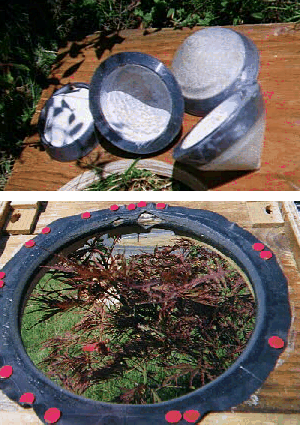 On the right is a photo of the hollow orbitals before they were glued together (that morning before the conference, EEK!).
Also in that composite photo (saving space on my site now ;), is what happened to the race after three minutes of running, this is the failed second retread.
Note that the contact surface is badly scuffed (wood showing through lace in some spots), and the total split is at the tail, where the torque direction reverses. The required motions for inertial propulsion are hard won indeed!
I built this model to have massive compression from the dual drive wheel, through the orbitals to the race, to insure traction, and the orbitals were small in relation to the orbit diameter (lowers thrust), to also increase traction life, and three minutes was all it lasted! I can understand why others who use smooth orbital versions are having trouble detecting thrust. The general reaction is to turn it faster, TOTALLY eliminating traction (and thrust) ever after!
Pendulum testing showed syncronization with the pendulum's natural period, and three lunges forward of the plumb line would then swing back across the line when a back swing of the orbital came into the natural rythm of the pendulum, so I think now that while the pendulum test will be good for more powerful, rapid impulse versions, it is NOT a good one for weak thrust detection, especially if the orbit rate is anywhere near the natural period. It makes for hilarious video though!
The water tests were also problematic, energy that might go into thrust is wasted in generating waves in a 360 degree radiation, and while I could see definite thrust while the unit was right next to the side of the pool (thrust line parallel with the near wall), the loss of visual references away from the sides, wind, waves, and too much co-motion, make the water test unsuitable for small thrust verification. If your design is as efficient as Britt Beaubian's, then water testing will be much more apparent, as his is!
The air table test (an air hockey table is what I used) can show small thrust quite nicely, and if air floated up to no solid contact with the table, this test virtually eliminates the "slip-stick" argument. A rather large float for the thrust unit helps eliminate, but not completely, the "tipped skirt" argument, which would be an average mass unbalance that would lift one side of the skirt for lateral air thrust. Don't want that!
I don't plan to do any more smooth orbital versions, they fail too regularly, almost always at the wrong time, and I can't afford to build a geared variant anytime soon, so I've decided to now work on the Thor's Hammer variant.
If you've already downloaded that page, try it again, I recently added a better drive for it, which allows for maximum torque to tangential translations, since the spinner arms can have more than their sector to move forward and back from their "lowest energy" relationship with the main axis. More latitude in it's axial accelerations allows for more "tail crowding" which results from the tangential accelerations, and thus more thrust from the spin translations is possible.
While I still want the word and work to spread, I must now reserve all reproduction rights for the materials on my site so we can have a ladder rung to start the climb to production of commercial units. Sorry about that, but of course, private use of my site materials is encouraged, and feel free to pass along my URL! ;)
Write me if you want to be on a notification list when published materials become available, (DON'T send ME any money unless it's an outright gift, I'm not TOO proud!;), as the "official" marketing business is not yet formed. It will be good to see if there is any real interest in such a thing, and one writing me represents many others (standard marketing stuff)! Telling me you are interested is not an obligation on your part, but I will email you to let you know when it's available.
SO if you want to see the Book, the CD with calculation programs, video and other neat stuff, or even the bloopers video, TELL ME SO, and your interest will facilitate it's arrival!
Plans are now to put together something marketable, a book, with a CD, containing video and programs that are being developed by other contributers to this project, and while I plan to learn video digitizing to get the "good stuff" on the net for researchers in the near future, the core group and I think it's now time to get serious about finances and commercial applications, if only information at first.
The Math able folks in our group are still worrying the figures, and trying to find a mathmatic proof of the principle, but it is SO hard to find where in "standard" equations and shortcuts the GIT deviates from known principles, but a "space lever" analog is being developed to examine.
 For those that understand that the centrifugal and tangential forces completely cancel out linear thrust in a "dumb weight" variable velocity orbit motion, we now can show that the orbital torque placed on the system can be analyzed by a "magic bullet" substitution.
The graphic on the right shows two blue arrows that represent the torque on the spinner arm in a Thor variant. If the two impulses from the torque that relate to the arm at a right angle to it, are replaced with a "magic bullet" impulse input from the outside, then it may aid those in deriving the proof.
An analogy that CAN be externally relevant may be achieved, yet still behave as though it were in a closed system, if the two opposed direction torque vectors are replaced with it's linear equivilant. Well, a dizzy linear equivalent! ;)
Of course, I say "magic bullets", because the orbital is traveling, and the analogous external impacts would have to come in from the 360 degree "sky" at just the right moments for it's momentary position, and must hit the arm in opposed (but offset) pairs simultaneously to accurately replace an angular force with a linear analog.
Perhaps the vectored substitution will aid those in analysis to break away from endemic assumptions that litter our habitual and often used equations, try it this way, see what happens! ;)
Another thought is to visualize the torque moments as momentary FULCRUMS in an acceleration reaction with the "fabric of the universe", inertial field, universal reference frame, the ZPE, or whatever your favorite term is for the everpresent connection to everything that lets matter "know" when it's being accelerated. Simple moment arm sums may also be a fruitful path to follow for the math!
Joao Andrade proved with experimentation that spinner torque will power the tangential acceleration. as is developed in the Thor's Hammer Variant, and the spin mass aspect of the orbitals do NOT figure into the total linear motion sum (by linear motion, I'm including angular motions that rotate from an axis outside of the center of that mass, as they are normally analyzed (tangential velocity divided by the radius)). A straight linear acceleration is just an angular one, with an infinite radius!
If all motions remain the same (tangential accelerations) for a GIT, we need now to analyze the torque componant in it's interaction with the tangential, and believe it or not, if you add the torque momentum transfer to the system into the tangential sum from the center of system mass's contribution (the axel), and say BOTH of them cancel the centrifugal, why, it would be a violation of the conservation of energy law! ;)
The centrifugal and tangential cancel out for linear considerations, as far as the center axel is concerned in those motion sums, and the tangential acceleration additions that are powered by reaction to the spin torque can NOT just be ignored, they just won't go away by ignoring them, nor is any alalysis that ignores these facts, applicable to this invention.
By having the ANGULAR mass accelerations carry some of the momentum input to the tangential motions, that amount HAS to be subtracted from their normal centrifugal balancing reaction on the center of system mass! Angular mass is that seperate yet coterminous mass aspect in a spin of any shaped matter, related to the ordinary mass known as the inertial moment, such as the angular mass for a solid sphere is I=2/5M, and a much better shape for the orbital, a thin ring mass, I=M!
It is an angular to angular momentum transfer (conservation of angular momentum), but the side by side tangential accelerations sum to a linear cancelation of the centrifugal, and the amount that you have reacting in a momentum transfer pair (mass to mass motion energy exchange) between the spin torque and the tangential, that "locked up" momentum literally in another dimension as spin around a seperate mass (Angular mass, whose linear mass is already accounted for), will no longer push back on the center of system mass, releasing that much of the centrifugal thrust to move you!
We've tried to eliminate all the unneccessary motions, but the three main force profiles must be juggled to achieve the formerly impossible. These three forces, the stronger centrifugal force caused by a variable velocity orbit, the tangential accelerations that speed up and slow down the orbital in reaction on the center of system mass (which includes the mass of the orbital), and the bilatterally reversing spin torques that now remove a portion of the tangential accelerations from canceling the centrifugal, and all are needed to translate spin accelerations into linear thrust. Interesting, since that's the very process that I've given to the world!
OK, still working on the right tools to communicate the concept with, I've a whole world to convince, so alternate points of viewing this device's explanations (oddly all also relevant) are being explored, please bear with me! ;)
ANYway, I'll be rebuilding my site this month, and at the same time adding new material. I am now recommending the Thor Variant for testing, as the smooth orbital versions are SO unreliable as to be worse than no tests at all for some folks! Many have been discouraged and use their own failed constructs as "proof" that the GIT doesn't work, and I'd like to eliminate that as a problem in achieving our next paradigm.
The Thor Variant page is my current focus, a local machinist is now working with me to build that variant, and with it's ability to vary it's thrust from zero to backwards to maximum thrust with only a voltage change, makes it in my mind, one that will emerge as the commercial design, rugged, reliable, and powerful!
Do stay tuned, this project is not going as fast as I'd like it to, but in review of the progress we've made, and with the growing number of variants and improvements that have come out of this effort, I don't feel too far behind after all! ;)
Watch this site for the public domain release from our associated inventors, a LOT of good stuff has been given to the world by our free thinkers, and my intention is to spell out those improvements, model them, and get them posted so others that might independantly try to patent can be forwarned.
I'm slowly adding back the volumes of information I had piled up here for over 15 months, if you want the old site sent to you as a zipped package, let me know, but realize it's a 3.6 meg package so the "free" email addresses will fail the transfer. Check back about the end of the month of September, and this site should be mostly filled out by then, in the mean time, check out the forums, always something new there!
Lots to do, so I'd better get on with it, talk with you later!
David E. Cowlishaw - 14 September 1998
New Alphabetic listing of this site will be updated regularly
Use the Old News link to download previous updates, a LOT of good info is to be found there and nowhere else!
Forums and Chat at:
http://www.ctoday.com/git
http://www.inter-corporate.com/forums/engineering.html
http://mercury.beseen.com/chat/rooms/w/4610/
* OLD NEWS * . NEXT UPDATE .^ TOP of Page ^ . * INDEX * . * SiteList *
.