*UPDATE 23*
Well now! Some of your may have wondered what has happened in this last time period, waiting patiently for a new update, so here it is!
My E-Mail Forum (link sends request to join our fun!), has been keeping be busy at LEAST 8 hours a day, often many more hours, mail now exceeding 25 letters a day, COOL!
The forum discusses all kinds of GIT related subjects, and ranges into construction techniques, space (and terrestrial) ideas, Q&A now also being answered by successful builders as well as myself, and I now have to stop "white-coat" bashing, we've got some serious folks now assisting our more mobile future, DOUBLE COOL!
Our numbers now include design engineers, graphic artists, machinists, some professors and teachers, multi-talents that, like myself, are bringing many disciplines into the arena, even a NASA employee, and a US Naval research scientist! Sometimes the subjects get down right whacky, but certainly focused around this new way to fly!
NEXUS magazine is out now on the streets in North America, so you'ld better hurry if you want to get a copy locally, only 20,000 copies are printed for the US and Canada. Duncan Roads (the main man and editor) did a WONDERFUL job of transcribing my gitplain.htm from active content to print, I looked RESPECTABLE even! ;)
Jeremy Goodall ran a nicely successful pendulum test! He reported a 2.5 inch race with two 1 inch bearings (about 2.2 ounces each), a total weight of 1 lb. 10 ounces including batteries, and it moved about 4 inches from plumb on 4, seven and a half foot strings, maintained for 10 seconds, when the battery connection vibrated off and it then swung back and forth as any pendular system will when you let it go from a height!
Using an equation one of our contributors provided, that calculates out to about 1.1 ounces of sustained inertial thrust! That's obviously not enough to self lift, but it DOES show the principle most convincingly to the doubtful hibrows! Jeremy is working on getting it set up again for video, and will soon have his own GIT web site!
Speaking of which, we have a growing number of websites sharing their GIT experiences now, so I'll list them for you here:
Amanda Gilbert (Core GIT Team business head) has a site exploring her views on the GIT!
Britt Beaubian has pictures and test videos of his successful constructions! His water tests are rather convincing.
Dann Mcreary has pictures of his GIT trials, with some tribulations, showing construction details as well.
Arthur H. Forge (of GITastrophy and first double conic tests) now has a web site as well! His link gets you to his "ezekiel.html" page, a nice rendered grouping of clustered GITs in a "circular lifting body/wing" that has characteristics strikingly similar to observed UFO behavior! Hmmmmm.......
Gabriel Ataya in New Zealand has graciously given us space for the test videos! You can find my selections of Britt's many water tests, and also, the original proof to me, James Hurl's "indiegit.htm" available on a fast and responsive server, Thanks Gabriel!
Charles North in the UK has a GIT site now! He's not yet built one, but is willing to collaborate with folks in his area (England), give his site a visit!
Several more GIT sites are rumored to me coming on line soon from around the world, DO check back for our growing "underground" internet laboratory!
Joao Andrade in Brazil has our first translation into Portugese, of my gitplain.htm document! I'm confident now that other translations into many more languages are on their way. If you would like to contribute by translating my pages for others in your native toungue, DO let me know, it would CERTAINLY be welcomed!
Joao has been very active in GIT development, some of which enable very high velocity devices needed for flight quality thrust. We are withholding certain details for patent purposes, but trust me, Joao is a real contributor in this new science!
He ran the tests suggested to verify the SpiderGIT (may it rest in peace) to a negative result, plain and simple, the counter torque on opposite sides model does NOT work! If you were one of the big companies that built that model (and weren't involved in our shared research), OOPS! Sorry about that! The email forum knew within days, thanks to Joao, so our researches could progress along proven lines.
One interesting experiment he did, was to put a motor out on a pivoting arm (axis parallel to the swinging motor), and it WORKED! The startup torque from the motor would push the swing arm one direction with the "bending moment" force of spin acceleration, and travel the other direction when the motor was decelerated (switched the juice off ;), so if not counter balanced by an opposing torque across a "teeter arm", it WILL provide a TANGENTIAL force on your spinner (arm) FROM THE MASS REACTION AROUND THE AXIS OF YOUR ORBITAL.
This explains how some of the reverse directed tangential forces are wrapped around the orbital, unloaded from your total linear system mass! Currently emerging is a side torque model of propulsion, since, if the linear mass actions are summed, it becomes zero (Joao has also programed a graphical output analyzer of a variable velocity thruster, and the total forces BEFORE CONSIDERING THE TORQUE COMPONENTS OF THE ORBITALS, sums to zero).
Hey! Not to worry, THAT'S GOOD! With the linear mass componant movements accounted for, now only the noseward torques placed on the frame from the orbitals at both sides (from the "outside" mass of the spin moments), needs integrated into the mix, then we'll have our mathmatic proof!
SO much going on, I don't have room to discuss it on the web site, but our output exceeded over 60 KB a day some time back, and I've need to get more "editorial", so our work will progress without "information overload".
DO visit the sites above, be SURE to check out Britt's water tests, and stay tuned to this site (and the associate sites as well!) for further developments. If you are interested in getting the latest information or contributing to our efforts Mail me, DavidC and say add me to the Inner GIT Circle!
I've removed the first 7 updates from the site, as well as taken the redundant appended statements I tack onto each update off of each update other than the current one to gain some more space, I have some more models and rendering I will be adding to the site a bit later. If you want those updates mailed to you, just ask!
WAY too much to do, to even discuss it in this update, though I will, as usual put exciting updates and info here when it comes in, Stay Tuned, and I'll talk with you later!
David Eugene Cowlishaw, Monday afternoon, 2 March 1998
 Let's try this again! I had posted an addendum to this update that included the following information, only to find my own files and the site to be the old update without my addition! Really weird stuff!
The picture at the left is a superimposed sphere on a double cone orbital to show why the race needs for the two are different. Where the skins of both intersect, the two types of orbitals would have the same contacts with the race at the nose and tail, but as you can see, the difference between the two requires that a race for a spherical orbital would be widened to the sides to make up for the "hips" of the sphere.
Many have had a hard time understanding why the final race configuration for a spherical orbital would be an oval that is wide to the sides, when the tipping of a circle off of the orbital plane would make an oval wide to the sides (and intuitively should be corrected by carving more from the front and back).
Of course the oval DOES get wide to the sides, and if the race angle is steep enough, very little carving would be needed on the race, since it will closely match the spherical orbital's needs. The actual contact path is described by a planer section of a torus.
A conical orbital, on the other hand, needs to be recircularized in the intuitive direction (carve front and back), if perfect circles are tipped off plane to achieve the race. A cylinder cut at angle describes this race profile. Is that clearer now?
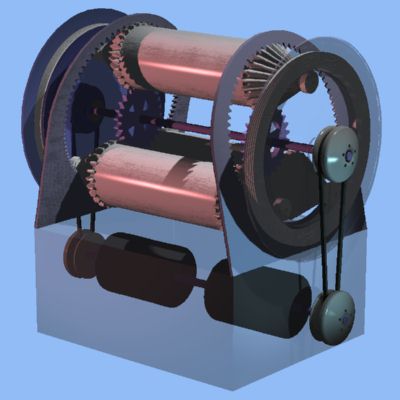 Pictured at the right is "Pegusus De Milo
 After I generated it, I thought what the heck, throw a saddle on it and gimmee the controls! The trouble is, with the gyroscopic precession characteristics, it would have to be sidesaddle...... What you say.... not you? Well think about it, lean forward, point the thrust up and forward easy enough, no gyro action to deal at right angles to.
Leaning to one side however, attempts to push one side down, and the gyreaction will turn that 90 degrees to become a yaw (rotate as though pinned through to the earth's surface), essentially your rudder action! YEEEEHAA!!!! GITTY UP! heheheh! (the white coats will probably drag me away from the prototype if I even TRY to mount this horse!)8
The rendering is not showing all of the parts of course, just the main layout, only one orbital (3 or 4 will be used), and several improvements that I can't tell you about will be added to this model, particularly Joao Andrade's improvement (Now released 6 March 98) that allows MUCH higher turning rates without grinding the gears into dust in short order!
More than 10 improvements and alternate variants to the GIT have been generated, a few are mine, most belong to the inventors who have joined in on collaboration to get this device into our world as soon as we can.
I've been encouraging the sharing of the burdens, and equally, the rewards, of getting our more mobile future engaged, and the ultimate fervent hopes of this author, occasional inventor, is to gather the awsome talents and focus of my respondants and co-inventors together in a place where we can allow our minds to create in an atmosphere (comes in real handy when you want to breath! ;), conducive to further innovation, and well, damnit, FUN!
More on that later. - DavidC - 8 pm Tuesday, 3 March 98
* SO SHARE !!! * * OLD NEWS * . NEXT UPDATE .^ TOP of Page ^ . * INDEX *